|
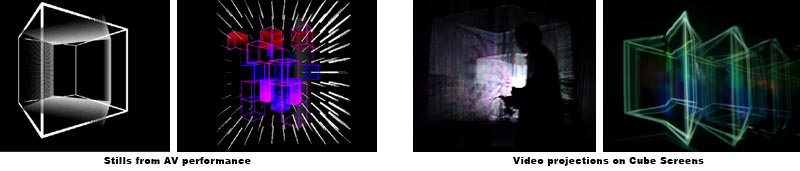
NOISE FEST REPORT Noise practitioners/ artists/ Scientists/ Creatives of all descriptions converged on Catalyst Arts for a 2 week noise Fest of unabridged experimentation. The artist-run gallery provided a free exploratory and collaborative space in which audience, performers and disciplines merged and fed off each other- where the only requirement for anyone who wished to participate in the event was to Bring the Noise. Pointless Creations were invited to participate in taking over the main gallery space with our Cube Screens installation- displaying the recorded output from the specially created "Cubic Noise" AV set we performed during the launch event.
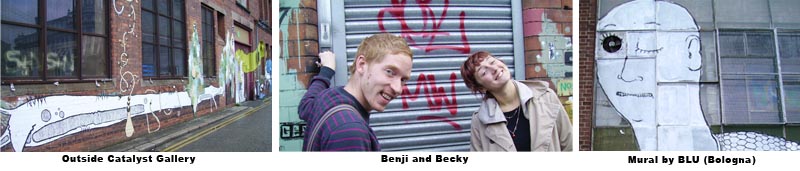
Catalyst is situated
in one of the vibrant districts of Belfast's city centre, its buildings
still bear the gloriously twisted legacy of the recent Urban
Eyes international street-art festival organised by the
collective. This provides a pleasant counterpoint to some of the more
"traditional" murals still present in other parts of the city.
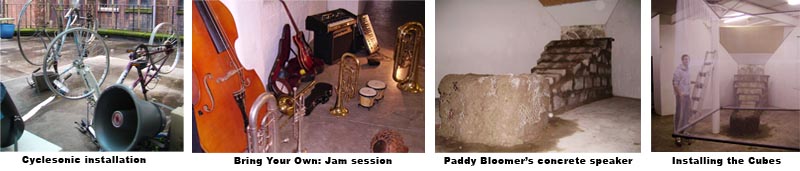
The patio roof got
fitted with the Cyclesonic installation by Tom Davis: through the use
of guitar pickups, feedback and overamplification, the Bicycle and its
environment took on a new sonic identity. The bicycle not only became
an instrument in its own right but also an an electrostatic receiver-
possibly decoding messages from the cosmos. Paddy Bloomer and
his team from the Speaker Construction Workshop settled on a giant folded
horn design for their Concrete speaker project assembled from breeze-blocks
and cemented to the gallery floor. The bass output from our AV composition
was diffused from this beast powered by a single 30w hifi amp driving
an 18inch cone to a cavernous effect.
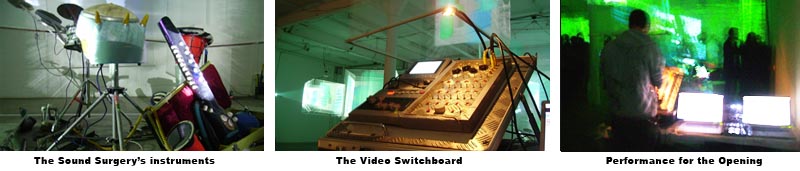
Our installation consisted of 4 rotating cube screens of varied sizes (from 1.2m to 2.5m sides) in an L formation catching 2 video beams of the same image. The centrepiece of the setup was the first ever retrospective display of the complete instrument collection from The Sound Surgery which Dav built and performed between 1995 and 2000. The Skitar, Drum Wheel, Traffic Drum, Bleeper, Headscan, Midi Hoover and Skins were bundled inside our largest cube screen and lit by the video flicker from 4 separate projectors. Being carefully protected from the audience's eager paws by the rotating mesh, the instruments caused much anticipation and frustration when it became apparent that they weren't going to be played on this occasion. As the precursors to our trusted Video Switchboard, these instruments's presence embodied a past quest for theatrical audio tools having their own aesthetics as the focal point of a visual physical performance. The foray from pure audio into audio+video performance eliminated the need for a physical stage presence which got replaced by an expanded screen environment- The Pointless performers control it from an unassuming perspective and the audience themselves take centre stage. This installation
aims to create a space where the physical structures , video images
and soundscape echo each other, yet these seemingly simple elements
combine to create an intricate environment.
AV performance: we
modelled a series of spinning cube shapes and designed ambient sound
layers we felt matched each of the video loop. We process these elements
in real time using 2 laptops (1 for sound- running Ableton, the other
for video- running Arkaos VJ). Using the Video Switchboard controller,
each switch activates a combination of an audio and video loop that
can be layered and further processesed using the software's real time
filters- matching audio and video filters is a trial and error process
as there is no direct link between the audio and visual distortion.
Once the audio and visual elements have been set (a process that could
be likened to tuning an instrument or creating a new drum kit using
unconventional elements), the composition can start to take shape in
an improvised manner- trying out combinations of AV loops and effects
using only the Video Switchboard (no need to worry any longer about
the computers at this stage) - the physical quality of the interface
makes the "Vusic" making experience very tactile and playfull,
it's all pressing big metal switches and wiggling sliders whilst getting
used to the response of the digital system without worring too much
about how it works (after all, do violin players really care about how
much stress is transfered through the bridge of their instrument whilst
playing?). Quicktime documentation: Links: |